235. Lowest Common Ancestor of a Binary Search Tree
Easy
Given a binary search tree (BST), find the lowest common ancestor (LCA) of two given nodes in the BST.
According to the definition of LCA on Wikipedia: “The lowest common ancestor is defined between two nodes p and q as the lowest node in T that has both p and q as descendants (where we allow a node to be a descendant of itself).”
Given binary search tree: root = [6,2,8,0,4,7,9,null,null,3,5]
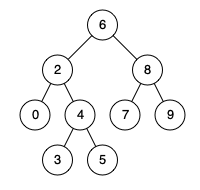
Example 1:
Input: root = [6,2,8,0,4,7,9,null,null,3,5], p = 2, q = 8 Output: 6 Explanation: The LCA of nodes2and8is6.
Example 2:
Input: root = [6,2,8,0,4,7,9,null,null,3,5], p = 2, q = 4 Output: 2 Explanation: The LCA of nodes2and4is2, since a node can be a descendant of itself according to the LCA definition.
Note:
- All of the nodes' values will be unique.
- p and q are different and both values will exist in the BST.
preorder (top down) to find p,q. LCA is the node when split happen.
1. if the root value is both larger than node p and q, LCA is in left subtree.
2. if the root value is both smaller than node p and 1, LCA is in right subtree.
otherwise, there is a split or the first present node of node p,q.
    public TreeNode lowestCommonAncestor(TreeNode root, TreeNode p, TreeNode q) {
        if(root == null)
            return null;
        if(root.val > p.val && root.val > q.val){
            return lowestCommonAncestor(root.left, p, q);
        }
        if(root.val < p.val && root.val < q.val){
            return lowestCommonAncestor(root.right, p, q);
        }
        return root;//where split happened
    }
Comments
Post a Comment